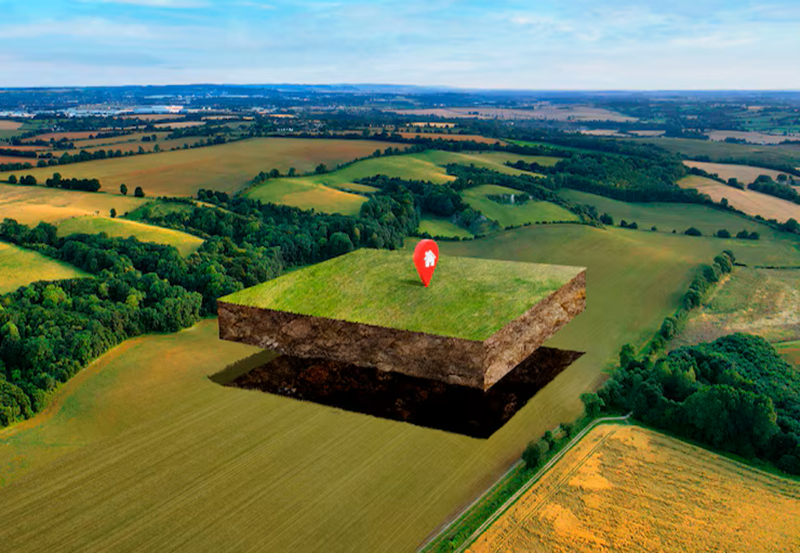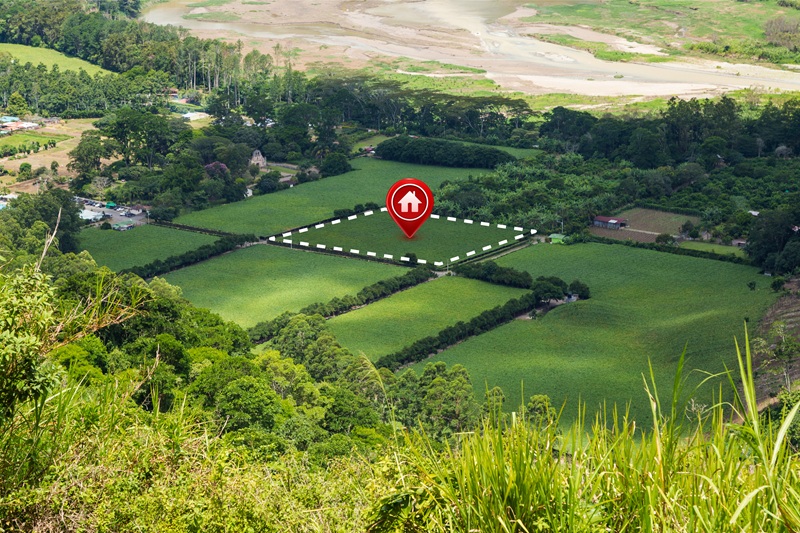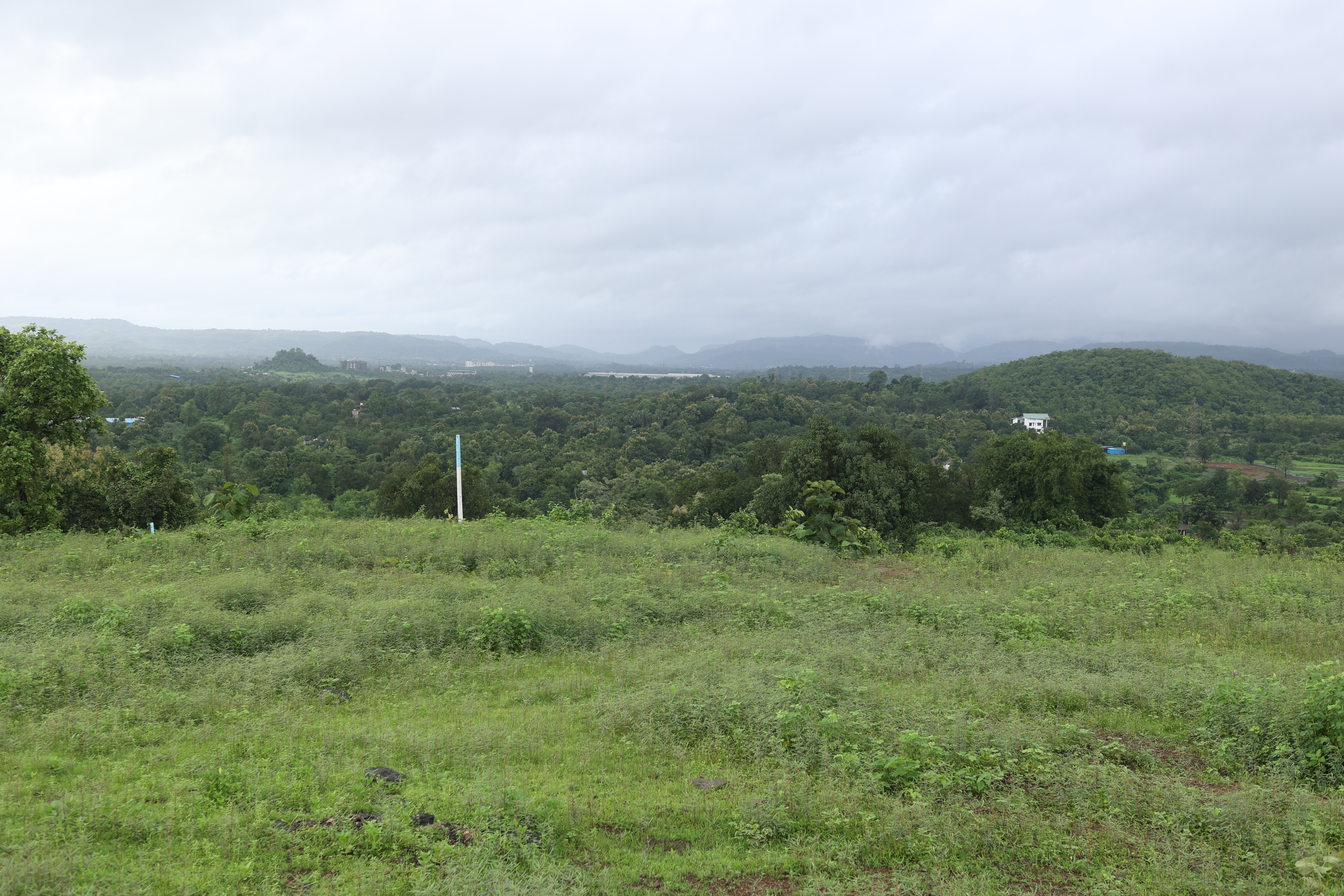


Buying agricultural land looks simple on paper, you pick a plot, agree on a price, and sign the papers. In practice, it's one of the easiest ways to lose money in Indian real estate if you skip one step: verification. Disputed inheritance, benami holdings, land under tenancy litigation, and boundaries that don't match what's on record are more common than most first-time buyers expect. That's why banks won't sanction a loan without it, lawyers won't clear a deal without it, and every experienced buyer or broker will tell you the same thing before you pay a rupee: verify the land, not just the seller's story.
This guide walks through what agricultural land verification actually involves the documents you need, how to confirm ownership and title, how to read a 7/12 extract if you're buying in Maharashtra, and the due diligence steps that stand between you and a deal you'll regret.
It's also the exact standard we hold ourselves to at Grow Farms. With 15 years in the Khopoli and Pali land market, every plot we list, including our Skybreez and Sarasview projects goes through the same title and land-record checks laid out in this guide before it's ever offered to a buyer. Whether you're verifying a plot on your own or looking at land that's already been through this process, the checklist below is worth knowing.
What Does Agricultural Land Verification Actually Mean?
Agricultural land verification is the process of confirming three things before you buy: that the seller genuinely owns the land and has the right to sell it, that the land itself is free of disputes, loans, or claims that could resurface after the sale, and that what's on paper actually matches what exists on the ground. It touches paperwork (title deeds, land records, mutation entries), the land itself (boundaries, classification, encroachments), and the people involved (the seller's identity, their share of ownership, and any pending litigation).
Skip this and you risk ending up with land you can't register cleanly, can't get a loan against, can't farm without a dispute, or can't resell without a court fight years later.
What Documents Should You Check Before Buying Agricultural Land?
Every state maintains slightly different revenue records, but the core agricultural land documents you should ask for and independently verify, not just accept from the seller are largely the same:
- Sale deed/title deed, along with the chain of previous sale deeds going back at least 30 years where possible
- 7/12 extract (Satbara Utara) in Maharashtra, or the equivalent land record Bhoomi in Karnataka, Bhulekh in UP, Adangal in Tamil Nadu, and so on
- 8A extract: the holder-wise summary of a person's total landholding in Maharashtra
- Mutation entries (Ferfar) showing every change of ownership on record
- Encumbrance Certificate (EC) for 13 to 30 years, showing any mortgages, loans, or legal claims registered against the land
- Property card, if any part of the land falls under non-agricultural or urbanised classification
- Land revenue tax receipts, to confirm dues are cleared
- Certified measurement or survey map from the Talathi, Tehsildar, or DILRMP records
- NA (Non-Agricultural) order, if the land has been converted, or confirmation that it's still classified agricultural
- Power of attorney documents, if someone other than the owner is signing on their behalf
- Legal heir or succession certificate, if the land came through inheritance
- No-objection certificates from co-owners, and from any recorded tenant under the state's tenancy law
Don't stop at photocopies the seller hands you. Pull the same records independently from the government portal or the Talathi/Sub-Registrar office and compare. This single habit catches most fraud before it becomes your problem.
How to Verify Agricultural Land Ownership
Ownership verification starts with a simple cross-check: does the name on the 7/12 extract (or your state's equivalent record) match the seller's ID and the name on the proposed sale deed? If there's a mismatch even a spelling difference, get it explained and documented before proceeding.
Next, check whether the land has multiple owners. Agricultural land in India is very often held jointly, especially when it's ancestral property under a Hindu Undivided Family. If there are co-owners, every one of them needs to consent to the sale and sign the deed, a sale by one co-owner without the others' consent can be challenged later, sometimes years after you've paid full price.
Finally, trace the mutation history. This tells you whether ownership actually transferred through registered, recorded transactions over time, rather than simply through possession or an unregistered family arrangement. A clean, unbroken mutation trail is one of the strongest signals that the seller's ownership will hold up.
How to Verify the Title of Agricultural Land
Title verification is different from ownership verification it's about tracing the legal chain of ownership backward through time, not just confirming who holds it today. This usually means pulling every registered sale deed for the land going back 30 years or more from the Sub-Registrar's office, and checking that each transfer in that chain was valid, properly registered, and free of any gaps.
Cross-reference this chain against the Encumbrance Certificate to rule out existing mortgages, court attachments, or pending liens. For anything beyond a small, low-value plot, it's worth paying a property lawyer for a formal legal title search report or title clearance certificate before you transfer any money this is standard practice for banks financing land purchases, and there's no reason a private buyer should accept less scrutiny.
What Is a 7/12 Extract and Why Is It Important?
The 7/12 extract also called Satbara Utara is Maharashtra's primary rural land record, maintained by the Revenue Department under the Maharashtra Land Revenue Code, 1966. The name comes from the two forms that make it up: Form VII (ownership and rights) and Form XII (cultivation and crop details). Together, they show the owner's name, the survey or gat number, the total area, the land-use or crop classification, and critically an "other rights" column that records any mortgages, tenancy rights, or encumbrances registered against the land.
For agricultural land in Maharashtra, the 7/12 extract functions the way a property card does for urban land. You'll need it to register a sale, apply for a crop loan, claim schemes like PM-Kisan, or simply confirm who's officially recorded as the owner. It matters for verification because it's the fastest, most authoritative way to catch a mismatch between what a seller claims and what the state actually has on record.
One distinction worth knowing: a plain copy viewed on the Mahabhulekh portal is free and fine for an initial check, but banks and the Sub-Registrar's office generally want the digitally signed version, which carries a QR code for authentication and currently costs around ₹15 through the Digital Satbara portal.
How to Check Agricultural Land Records in Maharashtra, Step by Step
Maharashtra's land records are fully digitised, so checking them yourself takes a few minutes rather than a trip to the Talathi's office:
- Go to the official portal, bhulekh.mahabhumi.gov.in
- Select the revenue division, district, taluka, and village where the land is located
- Search using the survey or gat number, or by the owner's name if you don't have the number
- View and download the 7/12 extract free of charge for an initial check
- For a digitally signed copy with a QR code needed for loans or final registration use digitalsatbara.mahabhumi.gov.in and pay the applicable fee
- Check the mutation (Ferfar) history through the Aapli Chavdi portal to confirm how and when ownership changed over time
If the land is outside Maharashtra, the same idea applies through your state's own portal Bhoomi in Karnataka, Bhulekh in Uttar Pradesh, Dharani in Telangana, and so on. The document names differ, but the verification logic is identical.
The Agricultural Land Verification Process, Step by Step
Put together, here's the sequence most lawyers and experienced buyers follow, roughly in order:
- Collect every document listed above directly from the seller
- Independently pull the same records from the Sub-Registrar's office and the Talathi/Tehsildar, and compare them against what the seller gave you
- Get an Encumbrance Certificate covering at least 13, and ideally 30, years
- Visit the site in person and physically walk the boundaries
- Confirm the land-use classification, and whether any NA conversion is pending or already granted
- Check for tenancy claims under the state's tenancy act a recorded tenant can complicate or block a sale
- Get a legal title search report from a property lawyer
- Verify the seller's identity and their legal capacity to sell age, mental competence, and authority if they're acting through a power of attorney
- Only register the sale deed once every one of the above has come back clean
What Should You Check During Agricultural Land Due Diligence?
Due diligence is really the verification process condensed into a final checklist before you commit funds. At minimum, confirm:
- The name on all records matches the seller and the proposed deed, with no unexplained discrepancies
- There's no pending loan, mortgage, or lien recorded against the land
- There's no ongoing litigation or civil case tied to the survey number
- The land-use classification matches what you intend to do with it
- The boundaries and area on record match what's physically on the ground
- There's no tenancy claim that could restrict transfer or use
- All co-owners and legal heirs, if any, have given documented consent
- Land revenue and property tax are fully paid up
- The holding doesn't breach limits under the state's Land Ceiling Act
- You're eligible to buy several states restrict agricultural land purchase to existing farmers or state residents, so confirm this before you go further, not after
How Grow Farms Verifies Land Before It's Ever Listed
If everything above sounds like a lot of legwork for a single purchase, that's because it is which is exactly why buyers increasingly prefer land that's already been through a verified process rather than negotiating directly with an individual seller.
At Grow Farms, this checklist isn't a formality, it's the filter every plot goes through before it reaches a buyer. With 15 years of experience in the Khopoli and Pali corridor and a team that averages 7 to 8 years of hands-on fieldwork, our process includes:
- Independent title verification and a documented chain of ownership for every plot
- Confirmation of clear 7/12 records and mutation history before a project is announced
- On-ground boundary and measurement checks, not just paperwork review
- Encumbrance checks to rule out pending loans, disputes, or litigation
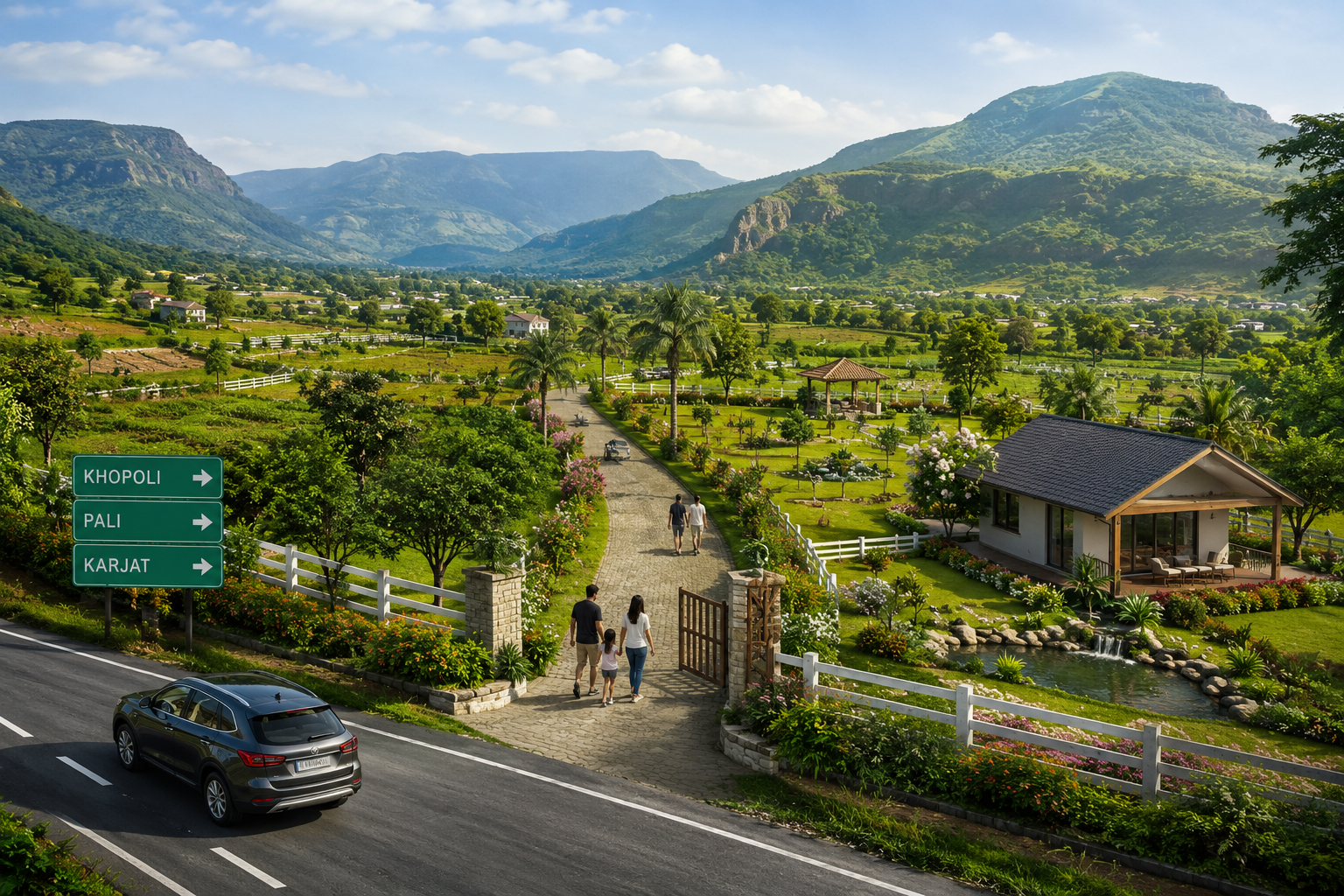
Our Skybreez project in Pali spans 114 acres and combines verified agricultural land with resort-style amenities for buyers who want a second home and a productive plot in one purchase. Our Sarasview project sits in a fast-developing pocket that's drawn interest from investors looking at long-term appreciation alongside agricultural use. Both are worth a look if you'd rather start from land that's already cleared this checklist than run it yourself.
How Do You Verify Agricultural Land Boundaries?
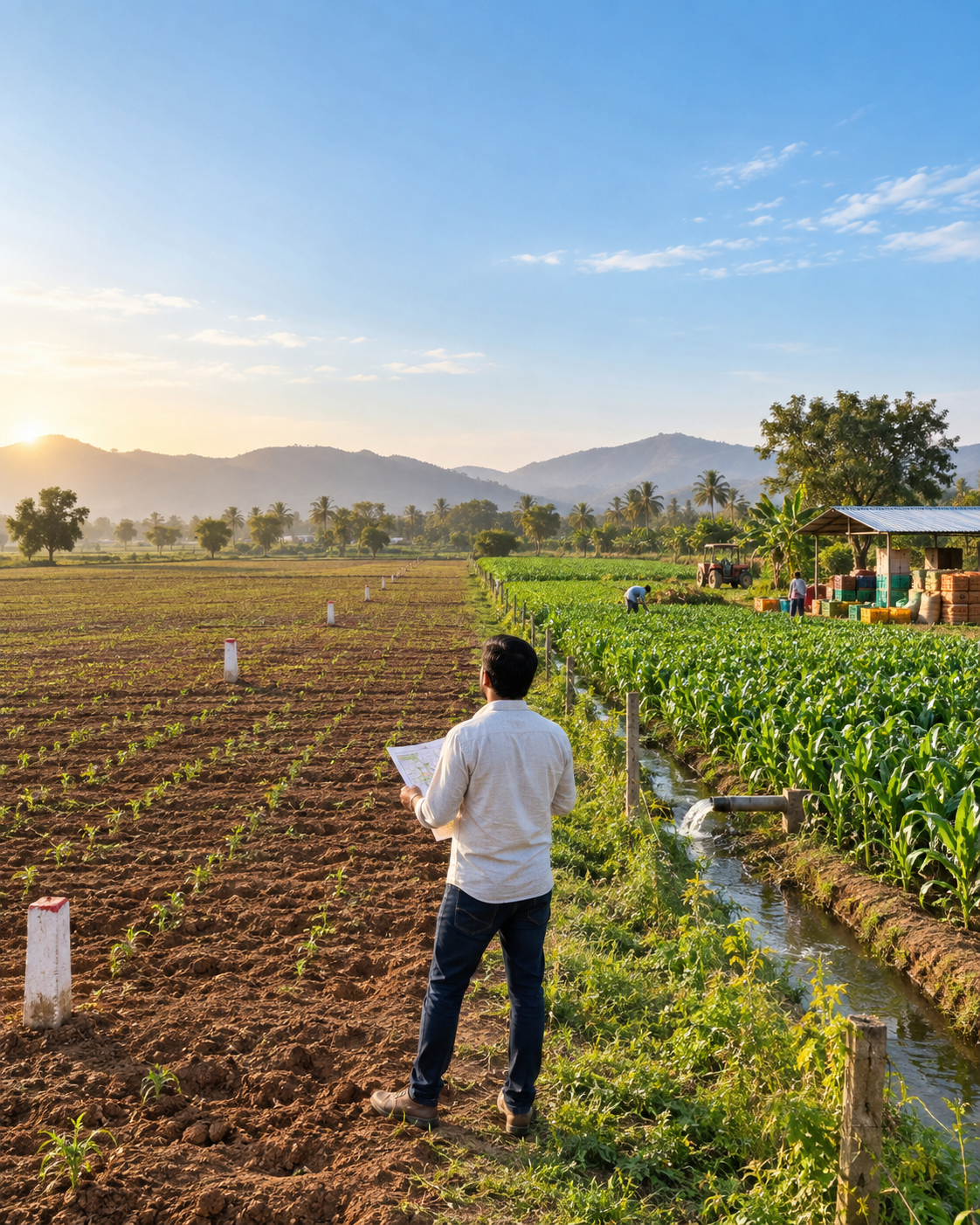
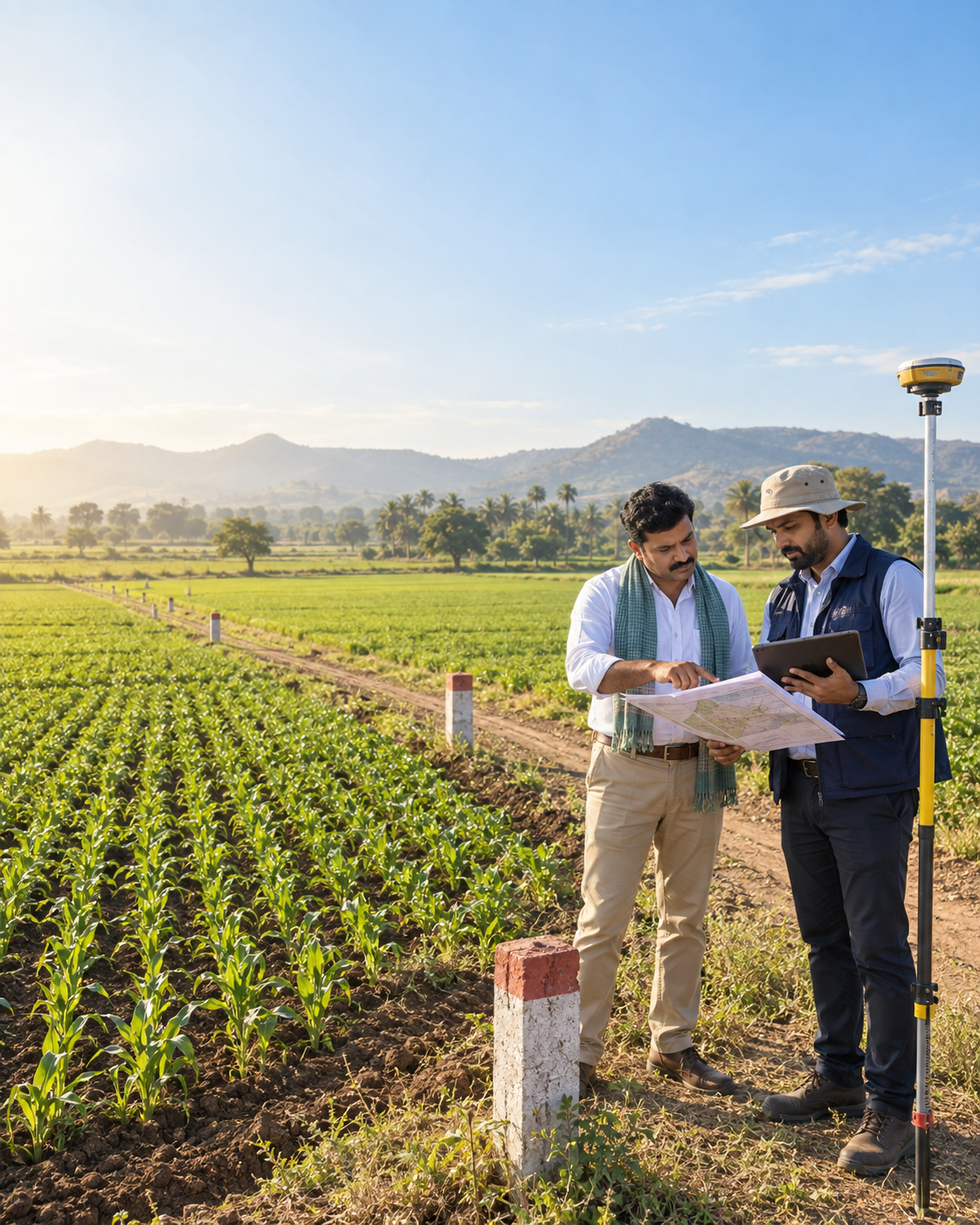
Boundary disputes are one of the most common problems buyers discover only after purchase, which is why a physical check matters as much as the paperwork. Start by obtaining a certified measurement or survey map from the Talathi or through DILRMP survey records. Then arrange a joint measurement on-site, ideally with the Talathi or a licensed surveyor present, along with the owners of the neighbouring plots.
Compare the area shown in the survey number against what's actually measured on the ground small discrepancies are common, but large ones are a warning sign. Look for encroachment from either side, and once boundaries are confirmed, get them marked with physical boundary stones and documented in a signed panchnama or boundary confirmation note countersigned by the adjoining landowners. This paper trail is what protects you if a neighbour later disputes the line.
Red Flags to Watch Out For
- The area in the sale deed doesn't match the area on the 7/12 extract or survey record
- The price is unusually low, or the seller is pushing for an unusually fast, cash-heavy deal
- The seller is reluctant to share original documents or insists on photocopies only
- The encumbrance certificate shows an entry you weren't told about
- Multiple legal heirs exist, but not all of them are party to the sale
- There's a recorded tenant, or a Land Ceiling Act matter still pending
- NA status is unclear when your plan requires non-agricultural use
Final Thoughts
None of this is complicated on its own it's just a lot of small checks that are easy to skip when you're excited about a plot and eager to close. The buyers who get burned are almost never the ones who did too much verification; they're the ones who trusted a seller's word over the government record. A few weeks spent pulling documents, checking the 7/12 extract, walking the boundaries, and getting a lawyer's title opinion is a small cost against the risk of buying into a dispute that takes years to untangle.
Thinking About Buying Verified Agricultural Land Near Mumbai?
If you'd rather skip the paperwork chase and start with land that's already been through full title and land-record verification, Grow Farms offers agricultural plots in Khopoli and Pali built for exactly this a second home, a working farm, or a long-term investment, without the guesswork. Take a look at Skybreez and Sarasview, browse more guides like this one on our blog, or get in touch directly to talk through what fits your budget and plans.
Frequently Asked Questions
Is agricultural land verification still necessary if I'm buying through a registered dealer or developer?
Yes. A registered dealer reduces some risk, but it doesn't replace verification the land records, title, and encumbrance status are tied to the land and the original owner, not to whoever is marketing the sale. Always verify independently regardless of who's selling.
How long does the agricultural land verification process usually take?
A straightforward case with clean, digitised records can be verified in one to two weeks. Cases involving inheritance, multiple co-owners, or older undigitised records can take four to six weeks or longer, especially if you need a 30-year encumbrance search or court record checks.
Can NRIs buy and verify agricultural land in India?
Under FEMA regulations, NRIs generally cannot purchase agricultural land, plantation property, or farmhouses in India, though they can inherit such land. If you're an NRI considering this, confirm your eligibility with a lawyer before starting any verification process, since the purchase itself may not be permitted.
What does agricultural land verification typically cost?
Costs vary by state and the depth of the search, but expect government portal fees to be minimal often under ₹100 for digitally signed extracts while a lawyer's title search report and encumbrance certificate fees typically run into a few thousand rupees, depending on the years covered and the complexity of the ownership history.
What happens if I discover the agricultural land has disputed ownership?
Walk away from the deal, or at minimum pause until the dispute is legally resolved. Buying land with pending litigation or disputed ownership means you inherit that dispute along with the land, and courts can take years to settle such matters during which your investment is effectively frozen and your title remains clouded.